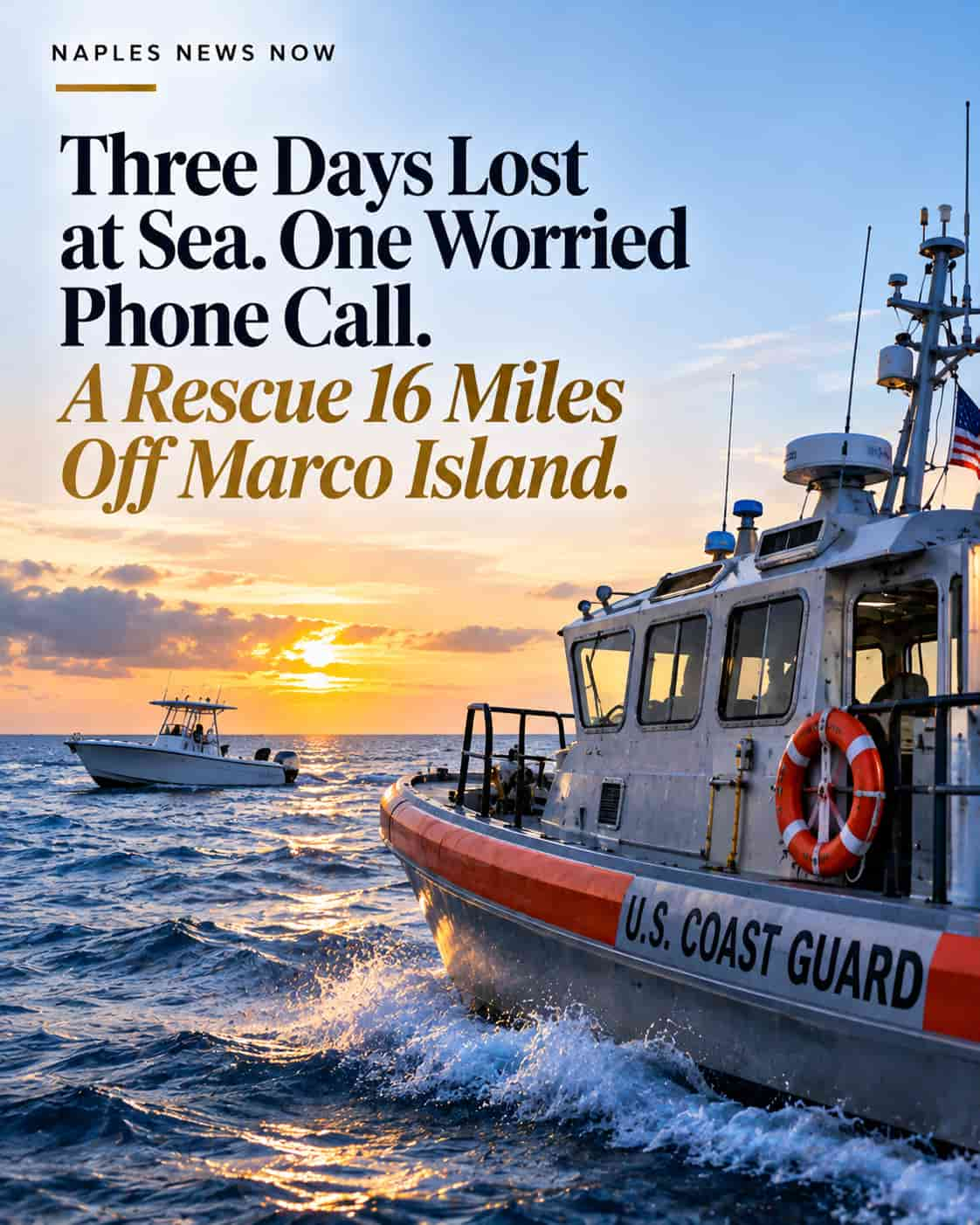
A man stranded in rough Gulf waters was found alive after someone noticed he hadn't been heard from. The rescue offers an important lesson for anyone heading offshore.
November 4, 2026 | Naples News Now
Sometimes, the difference between a missing person and a successful rescue begins with something remarkably simple.
Someone notices you haven't called.
That was an important part of a dramatic rescue off Marco Island last week, where a boater was found alive after reportedly spending three days stranded at sea aboard a disabled vessel.
He was approximately 16 miles southwest of Coon Key Pass, far enough offshore that a routine boating trip had turned into a potentially dangerous situation.
The man survived. He was brought safely back to Marco Island. And according to authorities, he suffered no reported injuries.
But the circumstances surrounding his rescue offer a powerful reminder of why every boater should make sure someone on land knows where they're going.
The Phone Call That Raised the Alarm
According to reporting by WINK News, the man had traveled to the Marco Island area to purchase a boat.
At some point, communication stopped.
More than 24 hours passed without anyone hearing from him.
Someone who knew about his trip became concerned and contacted authorities.
Marco Island public information officer Christian Davies told WINK that the caller explained the man had come to the area to buy a boat and had not been heard from for more than a day.
That concern helped set the search-and-rescue response in motion.
The U.S. Coast Guard subsequently coordinated with local marine emergency responders.
By Tuesday, October 27, the Coast Guard had lost communication with the boater, according to statements reported by local news outlets.
And somewhere offshore, the man remained aboard a vessel that had lost power.
Found 16 Miles Southwest of Coon Key Pass
On Wednesday, October 28, the search ended successfully.
The Collier County Marine Unit located the missing boater aboard his disabled vessel approximately 16 miles southwest of Coon Key Pass.
Authorities said he had reportedly spent three days at sea in extremely rough conditions.
The rescue involved several agencies working together:
-
U.S. Coast Guard
-
Collier County Marine Unit
-
Marco Island Police Department Marine Unit
-
Marco Island Fire Rescue
After the boater was located, Marco Island Fire Rescue's Fireboat 50 responded to the scene.
Paramedics evaluated and provided medical care to the man aboard the fireboat.
He was then transported safely back to Marco Island.
Meanwhile, Sea Tow recovered his disabled vessel and towed it separately.
Authorities did not release his identity.
Despite the ordeal, WINK reported that the man had no injuries.
Three Days Offshore. Several Questions Remain.
One of the most striking details is how little has been publicly established about the circumstances that left the boater stranded.
Authorities have not explained what caused the vessel to lose power.
They have not identified the type of boat, his intended route, or exactly when the mechanical problem occurred.
It is also unclear what communication equipment he had aboard or how search crews ultimately narrowed down his location.
And while officials said he spent approximately three days at sea, that does not mean the official search lasted three days.
What is confirmed is that someone on shore recognized the lack of communication, authorities coordinated a search, and marine responders located the man alive.
A Rescue Heard Across the Water
The search wasn't limited to emergency responders.
WINK also spoke with experienced sailor Steve Roseman, who heard the Coast Guard broadcasting information about the missing boater over marine radio while he was on the water.
Roseman explained that he carries an emergency locator device to help rescuers find him if something goes wrong offshore.
One such device is an Emergency Position-Indicating Radio Beacon, commonly called an EPIRB.
When activated in an emergency, a properly registered EPIRB transmits a distress signal through a satellite-based system, helping rescue authorities identify a vessel in trouble.
It's particularly valuable offshore, where cellular phone service may be unreliable or unavailable.
There is no confirmed information indicating that the rescued boater had an EPIRB or used one to summon help.
But the incident highlights why emergency communication equipment matters.
The One Thing Every Boater Should Do Before Leaving the Dock
The U.S. Coast Guard recommends that boaters leave a float plan with someone they trust before heading onto the water.
A float plan is simply a record of where you're going, when you expect to return, and what someone should do if you don't check in.
For Naples and Marco Island boaters, that information can be especially important when traveling into the Gulf or the Ten Thousand Islands.
A useful float plan includes:
-
Your intended route, destination, and expected return time.
-
The names and contact information of everyone aboard.
-
A description or photograph of your boat.
-
Details of your emergency communication equipment.
-
Instructions for contacting authorities if you're overdue.
The Coast Guard also recommends carrying a marine VHF radio and appropriate emergency signaling equipment, including an EPIRB for offshore boating.
A cell phone can be helpful, but it should not be your only means of emergency communication.
And if you're heading out alone, establish a specific check-in time with someone on land.
The key isn't simply telling someone you're going boating. It's making sure they know when to start worrying if you don't return.
A Team Effort That Ended With Everyone Safe
Marco Island Fire Rescue credited the successful outcome to teamwork, communication, and coordination among the responding agencies.
The department also recognized the Collier County Marine Emergency Response Team for its role in protecting people on Southwest Florida waterways.
It's easy to take that coordination for granted.
But finding a disabled vessel miles offshore requires responders to share information, deploy the right resources, and work together under potentially difficult conditions.
This time, the effort ended with the boater safely back on land.
The Bottom Line
A man traveled to Southwest Florida to buy a boat.
He ended up stranded offshore for approximately three days.
Someone who knew about his trip became concerned when he stopped communicating and called authorities.
That call helped initiate a response that ultimately brought him home safely.
For anyone who enjoys boating around Naples, Marco Island, or the Ten Thousand Islands, the lesson is worth remembering.
Before you head offshore, make sure someone knows where you're going—and when you're supposed to be back.
Because sometimes, the most important piece of safety equipment isn't on the boat.
It's the person on shore who knows you're missing.
Sources: WINK News, reporting by Brendan Brown, October 29–30, 2026; WBBH/Gulf Coast News Now, October 29, 2026; NBC 6 South Florida, October 2026; U.S. Coast Guard Boating Safety Division, recreational boating safety and float-plan guidance.