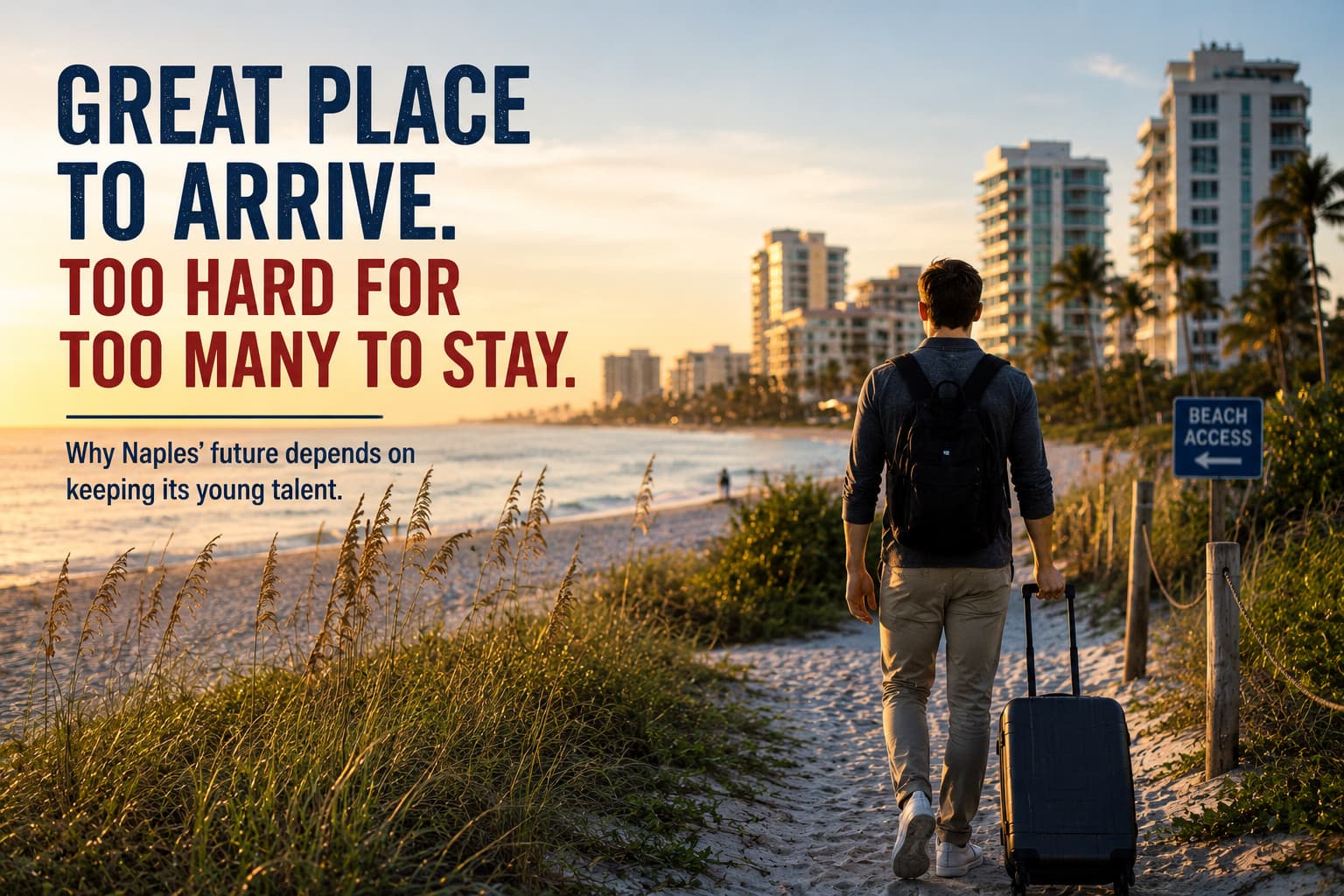
Naples is extraordinarily good at attracting people who have already made it.
The migration data proves it. The driver's license exchange numbers show it. The luxury real estate market confirms it every single month. Gen X professionals with established careers. Baby Boomers with retirement savings. High-net-worth households relocating from New York, New Jersey, and California with their income and their capital intact.
What Naples is not good at — and has not been good at for a long time — is keeping the people who haven't made it yet.
The college graduates. The young professionals in their mid-to-late 20s. The people who grew up in Collier County, went away to school, and then made a quiet calculation on the way back: Is there actually a career here for me? And came back with the wrong answer.
This is Naples' most underappreciated problem. And it's getting harder to ignore.
📊 What the Data Shows
The brain drain problem in Southwest Florida is not new — and it's not unique. But the dynamics that drive it in Naples are specific and worth understanding.
Florida as a whole does well at attracting college-educated transplants from other states. The migration data NNN reported last week showed New York up 9%, New Jersey up 8%, California up 16% year-over-year in driver's license exchanges to Collier County. Those people are not recent graduates. They are established professionals and retirees making deliberate lifestyle decisions with financial cushion behind them.
The people who don't show up in that migration data are the ones who left. The 22-year-old who graduated from Florida Gulf Coast University, looked at the Naples job market, and moved to Tampa where the tech sector is hiring. The 26-year-old nurse who trained at NCH, loved the work, and moved to Charlotte because housing was accessible on a nurse's salary. The 30-year-old attorney who passed the Florida bar and set up practice in Miami because the client base there matched a career at the level she was building toward.
Local organizations have been documenting this for years. Young Professionals of Naples has noted publicly that multiple studies show a young, active demographic is a leading factor in business growth — and that Southwest Florida has historically struggled to provide enough reasons for that demographic to stay. Their framing is blunt and accurate: Naples is mostly a playground for people who have already made it.
🔍 Why Young Graduates Leave — The Real Reasons
Housing costs. This is the biggest and most obvious one. A recent college graduate earning a starting salary in healthcare, education, hospitality management, or technology cannot afford to live in Naples at current rent levels. The 2026 ATTOM Rental Affordability Report found Collier County is the least affordable rental market in the United States — the only place in America where median rent exceeds median wages. A 23-year-old making $48,000 a year facing $1,800-a-month rents for a one-bedroom does the math and moves somewhere the math works.
Career trajectory limitations. Naples has excellent employers in specific sectors — healthcare, real estate, financial services, hospitality, and legal services serving a high-net-worth clientele. Compared with larger Florida metros, Naples has far fewer career opportunities at scale in technology, media, advanced manufacturing, academic research and the creative industries.. A computer science graduate, a marketing professional, a data analyst, a film editor, a materials engineer — these careers don't exist in Naples at meaningful scale. They exist in Tampa, Miami, Orlando, and Austin. Young professionals with those degrees follow the jobs.
The social infrastructure gap. Cities that retain young professionals have a critical mass of people the same age. Bars that aren't restaurants. Music venues that aren't country clubs. A dating pool. A social scene that doesn't require either a membership or a retirement plan to participate in. Naples has improved — Only Doubles, The Rooster, FC Naples, Dogtooth — but the infrastructure remains thin compared to cities that successfully retain young talent.
The perception problem. Naples has a brand identity that actively works against young professional retention. When a 25-year-old thinks about Naples, they think about where their grandparents vacation. That perception — however unfair — affects recruiting, social media representation, and every signal a young person uses to decide whether a city is for them.
💡 What It Would Take to Fix It
None of this is unsolvable. Cities across the country have reversed brain drain trajectories within a decade when the right combination of intentional policy and private investment came together. Here's what that looks like for Southwest Florida specifically.
1. Look East — Ave Maria and the I-75 Corridor Are the Answer to the Land Problem
Here's the angle most people miss entirely: the brain drain problem doesn't have to be solved inside the City of Naples. It can be solved in the region — and the eastern corridor gives Southwest Florida something almost no major coastal market has: vast land at accessible prices.
Ave Maria is the most obvious example. The master-planned university town 30 miles east of Naples has large parcels available at a fraction of coastal land costs, an existing university generating student foot traffic, and infrastructure that was designed with growth in mind. A technology campus, a medical innovation district, a creative industries hub, or an entrepreneurship center built in the Ave Maria corridor could attract companies and young workers who want the Southwest Florida lifestyle without the Southwest Florida price tag.
Think of it as the Austin model applied locally. Austin, Texas became a technology magnet not because downtown Austin is affordable — it isn't — but because the broader metro offered accessible land, a research university, and a quality of life that made young professionals choose it over San Francisco and New York. The FGCU and Naples COM campuses, the Ave Maria University community, and many acres of developable land east of I-75 are the raw ingredients for the same dynamic. The missing piece is coordination and intentional investment.
2. Draw From Florida's East Coast — Stop Thinking of Naples as Just a Naples Problem
Naples is not competing only against Tampa and Miami for young talent. It is also competing against — and could be drawing from — Fort Lauderdale, West Palm Beach, Boca Raton, and the entire southeastern Florida corridor where young professionals are already employed but increasingly priced out of their own neighborhoods.
The drive from Fort Lauderdale to Naples on Alligator Alley is 1 hour and 45 minutes. Young professionals priced out of Broward County's rental market — where one-bedrooms routinely exceed $2,500 — are already looking for alternatives. A coordinated regional marketing effort that targets the Southeast Florida corridor — not the Midwest, not the Northeast, but the state's own internal migration — could redirect some of that movement westward.
The pitch practically writes itself: the same Florida sunshine, Gulf Coast beaches, a high quality of life, and the flexibility of remote work that allows professionals to build careers with companies headquartered almost anywhere. The companies don't necessarily need to be here. The workers can be. Yet Southwest Florida has never made a serious, coordinated pitch to young professionals already living in Florida who may be looking for an alternative to the cost, congestion, and pace of Southeast Florida.
3. Take Affordable Housing for Working Professionals Seriously
The affordable housing conversation in Naples almost always focuses on the lowest income brackets — the farmworkers, the hotel housekeepers, the restaurant staff. That conversation is necessary. But it misses the workforce band most critical for brain drain: the $45,000-to-$80,000 earner. A teacher. A beginning attorney. A registered nurse. A junior financial analyst.
These people are not in poverty. They are simply priced out of a market calibrated for people three income brackets above them. Targeted workforce housing programs — employer-assisted housing, below-market workforce rental developments, down payment assistance for first-time buyers earning between 80% and 120% of area median income — can change that calculus. The Ave Maria corridor, with its lower land costs, is the most logical place to build this housing at scale. A 30-minute commute from an affordable Ave Maria home to a Naples employer is a tradeoff many young professionals would make immediately.
According to a 2023 FGCU/Lightcast study cited by Collier County’s housing initiative, 52,749 people commute into Collier County for work every day — including more than 15,800 from East Coast counties. In other words, tens of thousands of people already have jobs here, but their homes — and much of their everyday spending — remain somewhere else.
4. Build the Tech and Innovation Sector Intentionally
Naples has the capital, the real estate, and the philanthropic infrastructure to attract technology companies. What it lacks is a coordinated strategy. A designated innovation district — a physical address where startups, accelerators, co-working spaces, and early-stage companies cluster — would give young technical talent somewhere to work that isn't a hotel or a hospital. A public-private partnership to create that district, potentially anchored in the Ave Maria or eastern I-75 corridor where land costs don't make startup economics impossible, could generate career reasons to stay for a generation of FGCU and COM graduates.
5. Engage FGCU and the New Medical School as Talent Pipelines
FGCU graduates thousands of students annually within 40 miles of Naples. The Naples College of Osteopathic Medicine will produce 100 physicians a year by the mid-2030s. Both institutions are currently treated as workforce pipelines — we train them here and watch them leave for cities with more career opportunity.
The better model treats both schools as talent recruitment systems. Structured internships with Collier County's major employers. Post-graduation job placement with guaranteed interviews at local firms. Cohort programs that give graduating students a peer community in Naples so the social infrastructure problem doesn't drive them to Tampa the first week after graduation. NCH already does some of this with clinical rotations. Expanding it systematically is a matter of organizational will and modest funding.
6. Make It a Stated Priority — Out Loud, Publicly, With Metrics
The single most underrated tool for reversing brain drain is leadership that names the problem and commits to solving it. When a mayor, a chamber of commerce, a community foundation, or a major employer publicly commits to keeping young talent in Southwest Florida — with specific programs, specific targets, and specific accountability — it changes the signal the city sends to every recent graduate deciding where to build a career.
Naples has not done this in any sustained, coordinated way. The organizations working on it — Young Professionals of Naples, the Greater Naples Chamber's emerging leader programs — are doing so without the unified community commitment that actually moves the needle.
🌴 Why This Matters More Than It Looks
Naples' current prosperity is real. The luxury real estate numbers, the tourism revenue, the Four Seasons, the Ritz-Carlton Residences, the $40 million Port Royal closings — all of it is working by every conventional metric.
But it is working for and because of the generation that is currently here. The Baby Boomers and older Gen Xers who relocated their wealth and their property purchases to Naples are the engine of the current economy. They are also aging. The $366 million the Naples Winter Wine Festival has raised for children's causes over 25 years ultimately depends on the community having children and families at its center — not just donors writing checks from a guest villa.
The medical school the city is building needs to produce doctors who stay and practice here, not doctors who train here and leave for cities where their peers are building careers.
The school district carrying a $42 million deficit needs to hire and retain teachers — people in their 20s and 30s who can afford to live in the community where they teach.
Every business in Naples is competing for the same diminishing pool of working-age talent. The ones that can't find it will automate, consolidate, or move.
The city that attracts everyone who has already made it needs to become the region where people come to make it. That transition requires thinking bigger than Naples' city limits — east toward Ave Maria and the open land of the I-75 corridor, and east across the state toward the young professionals of Fort Lauderdale and Boca Raton who are already looking for something better.
The land is there. The universities are there. The quality of life is there. What's missing is the decision to compete for the people who are still becoming what Naples has always attracted after the fact.