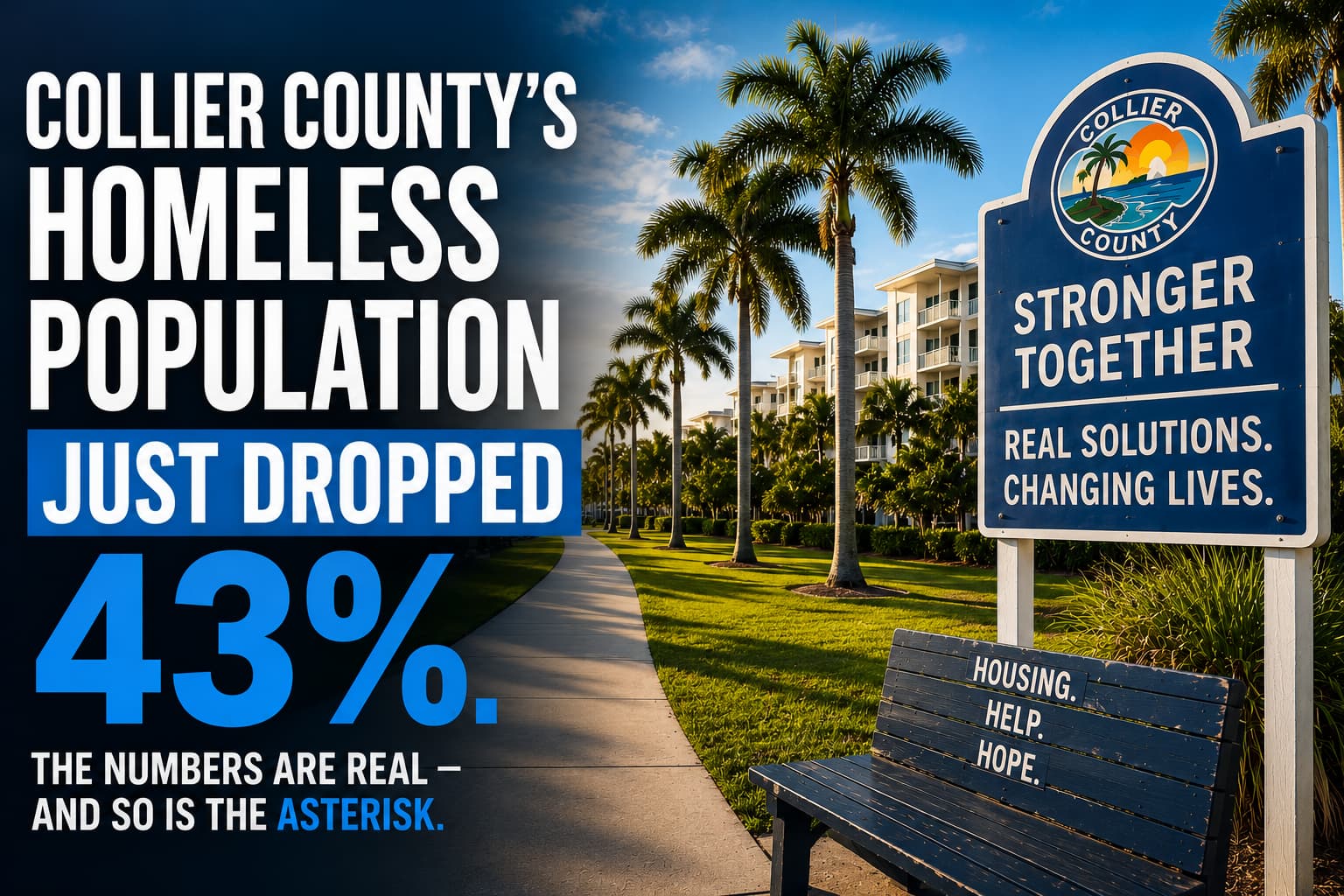
The annual Point-in-Time homeless count in Collier County recorded a 43% decrease in the number of people counted this year. That is a significant number in a county that has been grappling with homelessness in the shadow of some of the most expensive real estate in Florida, and it deserves both credit and context.
📊 What the Count Found
Every year, volunteers fan out across Collier County before dawn, walking parking lots, wooded areas, parks, and encampments they've mapped over years of outreach work. They set up base camps in spots they know the unhoused will be. They ask questions, hand out supplies, and try to count people who often don't want to be counted. The annual census of the unhoused provides a snapshot of the lives of those on the streets by asking about drug addiction, domestic violence, military service, and many other circumstances.
The headline from this year's count is the 43% drop. The data underneath it is just as important.
Veteran homelessness dropped dramatically, from 40 homeless veterans counted last year to just 12 this year. Michael Overway of the Collier County Continuum of Care described it as a huge win, noting that outreach teams are seeing very few homeless veterans in the camps. That outcome is the result of years of targeted services and federal housing programs specifically designed for veterans, and it's working.
👨👩👧 Who Is Unhoused in Collier Now
The face of homelessness in Collier County is changing. For the first time, the newly homeless, made up mostly of elderly individuals and single parents with children, are starting to outnumber the chronically homeless.
That shift is significant. Chronic homelessness, people with long-term substance abuse issues, mental illness, or both who cycle in and out of shelters for years, has historically been the most visible and most difficult-to-serve population. The fact that first-time homeless individuals now outnumber them in Collier County tells a specific story about the local economy.
An elderly person who can no longer afford rent in Naples, or a single parent whose housing costs ate through their savings after a job loss or a medical bill, those are not the same circumstances as someone who has been unhoused for a decade. They often respond faster to services and have a better chance of finding stable housing once connected with resources. But they also signal something about what's happening in the broader community: the cost of living here is producing a new category of person who never expected to need help.
⚠️ The Asterisk: Numbers Don't Tell the Whole Story
Overway and the WGCU reporting team have been careful to frame the 43% decrease with important caveats. Point-in-time counts are a single-night snapshot. They capture people who are visible and willing to be counted, which is never everyone.
Some people refuse to participate. One man encountered by outreach workers during this year's count didn't want to be counted but did take the information being handed out. The people who say no don't disappear from the problem; they just disappear from the data.
The county is also still grappling with the structural conditions that produce homelessness in the first place. Overway has previously noted he's not surprised by homelessness figures in Collier given that it is considered the second richest county in the state. High wealth and high costs of living exist side by side, and the gap between them is where homelessness lives.
🔭 What's Actually Working
The veteran numbers are the clearest evidence that targeted, well-funded services produce results. Programs specifically designed to connect veterans with housing vouchers, case management, and wraparound support have moved the needle from 40 to 12 in a single year in Collier County. The county is nearing what Continuum of Care officials describe as a major achievement in effectively ending veteran homelessness locally.
The broader question is whether that same targeted energy can be applied to the growing population of newly homeless elderly residents and families, people whose path to the street was economic, not addiction-driven, and whose path back to stability is in theory shorter if the resources meet them in time.
A 43% drop in the headline count is real progress. Collier County's outreach workers, shelter operators, and nonprofit partners put in the work that produced it. That work deserves recognition.
The asterisk is not an argument against celebrating. It's an argument for not stopping.
Information sourced from WGCU's May 18 and May 24, 2026 reporting by Eileen Kelley and Andrea Melendez, and the Collier County Continuum of Care.