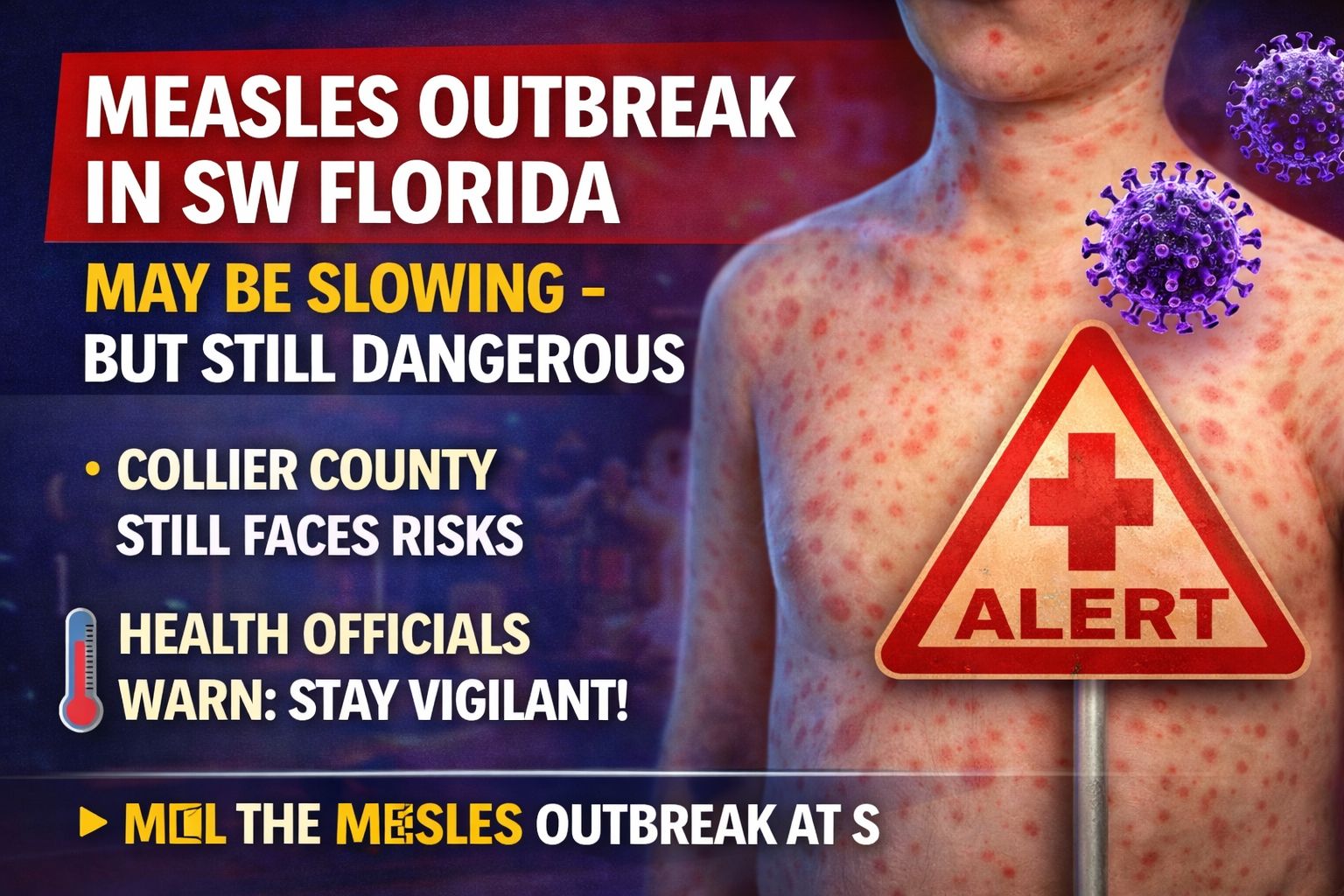
After weeks of rising case numbers and growing concern across Southwest Florida, there may finally be a small sign of relief.
Health officials say the measles outbreak centered in Collier County — one of the largest in the state this year — appears to be slowing, though experts caution the situation is far from over.
The virus has infected dozens of people across the region, with the majority of cases concentrated in Collier County and linked in part to an outbreak at Ave Maria University, where clusters of infections spread among students earlier this year.
Even as the pace of new cases begins to stabilize, health officials say the community still faces risks.
Collier County Became the Center of Florida’s Outbreak
At one point this winter, Collier County accounted for roughly three-quarters of Florida’s measles cases, placing the Naples area at the center of the state’s outbreak.
State data showed more than 100 measles infections statewide, with the majority tied to Southwest Florida.
In some weeks, the county reported dozens of confirmed and probable cases, including infections linked to schools and the Ave Maria University campus.
One case also involved an infected visitor briefly present at Naples Classical Academy, prompting precautionary measures at the school, though no additional cases were reported there afterward.
Why the Spread May Be Slowing
Public health officials say several factors may be contributing to the recent slowdown in new cases.
• increased awareness across the community• vaccination efforts and medical monitoring• isolation of infected individuals
• campus mitigation measures at Ave Maria University
Health agencies have also been working closely with schools and healthcare providers to identify potential exposures quickly and prevent additional transmission.
While the trend is encouraging, experts say measles outbreaks often move in waves, meaning case numbers could still fluctuate.
One of the Most Contagious Viruses on Earth
Measles spreads easily through the air and is considered one of the most contagious viruses known.
Medical experts estimate that up to 90% of unvaccinated people exposed to measles will become infected.
Symptoms typically include:
• fever• cough• runny nose• red eyes
• a distinctive rash that spreads across the body
Because the virus can remain in the air for hours after an infected person leaves a room, outbreaks can spread quickly in close environments such as schools or college campuses.
A Larger National Trend
The outbreak in Southwest Florida is also part of a broader resurgence of measles across the United States.
After the disease was declared eliminated in the U.S. in 2000, cases have returned in recent years as vaccination rates have declined in some communities.
Health officials say most measles infections occur among individuals who are unvaccinated or whose vaccination status is unknown.
What Health Officials Want Residents to Know
Despite signs the outbreak may be stabilizing, public health experts say residents should still remain vigilant.
• staying home if measles symptoms appear• contacting health providers before visiting clinics• checking vaccination status for children and adults
• monitoring public health advisories for exposure alerts
Healthcare providers across Collier County are continuing to monitor patients and work with the Florida Department of Health to track potential new cases.
The Bottom Line for Naples
For now, the worst of the outbreak may be easing — but the virus hasn’t disappeared.
With Collier County still accounting for a large share of Florida’s measles cases earlier this year, health officials say the region remains under close watch as the community moves through the spring season.
The message from doctors and public health officials is simple:
The outbreak may be slowing — but Southwest Florida isn’t out of the woods just yet.
This story is based on reporting from Naples Daily News and regional health reporting.