The story begins with two Kentucky businessmen, a stretch of Gulf Coast wilderness and a land purchase that worked out to just $3 an acre.
Every city has a name. But not every city has a name that started as a real estate sales pitch.
Long before Fifth Avenue South became a dining destination, before beachfront mansions and championship golf courses, Naples was a small Gulf Coast settlement with few connections to the outside world.
Then two businessmen from Kentucky arrived with an ambitious idea: turn this remote stretch of Southwest Florida coastline into a winter retreat for wealthy Northerners.
They gave their new community a name associated with sunshine, beautiful water and European elegance.
Naples. As in Naples, Italy.
And the story of how that happened is almost as interesting as the price they paid for the land.
Two Kentuckians and a Boat Ride
In 1885, former Confederate general and U.S. Senator John Stuart Williams joined forces with Walter N. Haldeman, publisher of the Louisville Courier-Journal.
The men traveled along Southwest Florida's coast, exploring the possibility of establishing a new resort community.
According to the City of Naples' historical account, Williams had become interested in the region after reading descriptions from government surveyors. He recruited Haldeman, and the two chartered a boat to explore the coastline.
What they found was a long stretch of Gulf beaches with a natural bay behind it.
They saw the potential for something much bigger than a remote coastal settlement.
The Original Naples Real Estate Deal: $3 an Acre
In the autumn of 1886, the Naples Town Improvement Company was established to develop the area as a winter retreat.
The company acquired approximately 3,712 acres between the Gulf of Mexico and what is now Naples Bay for $11,136.
That works out to just $3 per acre.
Those figures are documented by the Naples Historical Society.
Of course, this wasn't the Naples we recognize today. Transportation was difficult, infrastructure was limited, and the investors still had to convince people that the area was worth visiting.
That's where the name came in.
So Why Naples, Italy?
Throughout the late 1800s, promotional accounts compared Southwest Florida's warm climate, coastal scenery and abundant fishing with the Italian peninsula.
The name Naples became associated with descriptions of the local bay that invoked the famous Bay of Naples in Italy.
The connection was appealing to the investors developing the new community. The Naples Historical Society records that the company was established in 1886 to create a town named Naples, reminiscent of the Italian peninsula, and develop it as a winter retreat.
The comparison wasn't a claim that the two places were geographically identical.
It was an invitation to imagine what the Florida community could become.
The developers were selling more than land. They were selling the possibility of spending winter somewhere beautiful, warm and far removed from the cold northern states.
In that sense, Naples had a recognizable destination brand before it had much of a town.
The First Big Attraction Wasn't the Beach. It Was a Pier.
There was one rather important problem with the investors' vision.
Getting to Naples wasn't easy.
Before railroads and modern highways connected the region, visitors and supplies relied heavily on boats.
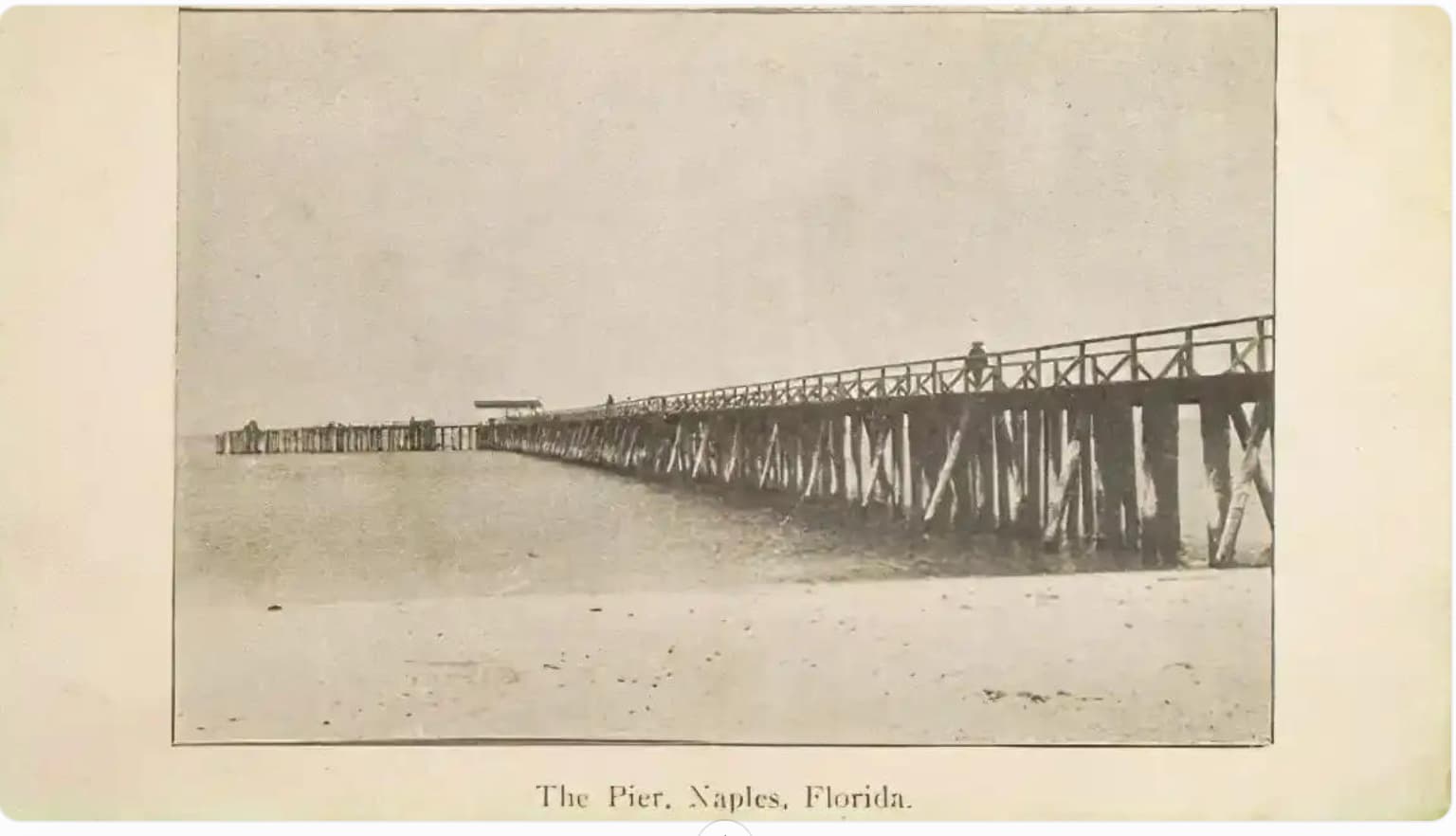
The Naples Company responded by developing one of the community's earliest and most important pieces of infrastructure: a 600-foot pier extending into the Gulf of Mexico.
Construction began in 1888, providing a practical connection for passengers and supplies arriving by water.
The first Naples Hotel followed, opening in 1889.
And here's a wonderful detail: according to the Naples Historical Society, its first guest was Rose Cleveland, sister of President Grover Cleveland.
The original pier wasn't built primarily as the sunset gathering place we associate with Naples today. It was essential transportation infrastructure for a community trying to establish itself.
The town eventually grew around those early investments.
Naples Wasn't Empty Before the Investors Arrived
There's another part of this history worth remembering.
Although Williams and Haldeman are associated with the founding of modern Naples, people lived in Southwest Florida long before their arrival.
The Calusa inhabited the region for centuries, establishing communities and sophisticated coastal settlements.
The City of Naples also identifies Rodger Gordon and Joe Wiggins among the area's early non-Indigenous pioneers around 1874, with John and Madison Weeks settling near present-day Gordon Pass in 1876.
The Kentucky investors didn't discover an uninhabited coastline.
They established the planned resort community that would eventually grow into the modern City of Naples.
Did the Original Naples Investment Pay Off?
Despite the optimistic beginnings, the Naples Town Improvement Company struggled financially.
By 1890, the company was auctioned off, with Walter Haldeman acquiring its remaining assets, including the hotel, pier, ships and undeveloped property, for $50,000.
The investors' dream of an instantly successful resort destination had run into the practical difficulties of developing an isolated community.
So did the vision of Naples as a place where people from colder climates would come to enjoy the Florida sunshine.
Over the following century, the community evolved into something its original promoters could scarcely have imagined.
One Name. Two Very Different Cities.
Naples, Italy, has Mount Vesuvius, centuries of architecture and one of Europe's most recognizable coastal landscapes.
Naples, Florida, has white-sand beaches, mangrove-lined waterways, Gulf sunsets and an identity entirely its own.
The cities aren't identical. They don't need to be.
What our Naples borrowed from its Italian namesake was an association with coastal beauty, warmth and the appeal of getting away.
And perhaps the most fascinating part of the story is that the original concept remains remarkably familiar.
Nearly 140 years after two Kentucky businessmen purchased land for $3 an acre, people still come to Naples for many of the same reasons those early promoters emphasized: the climate, the coastline and the promise of a different pace of life.
The city has changed enormously. The original sales pitch? Not nearly as much.




.jpg)