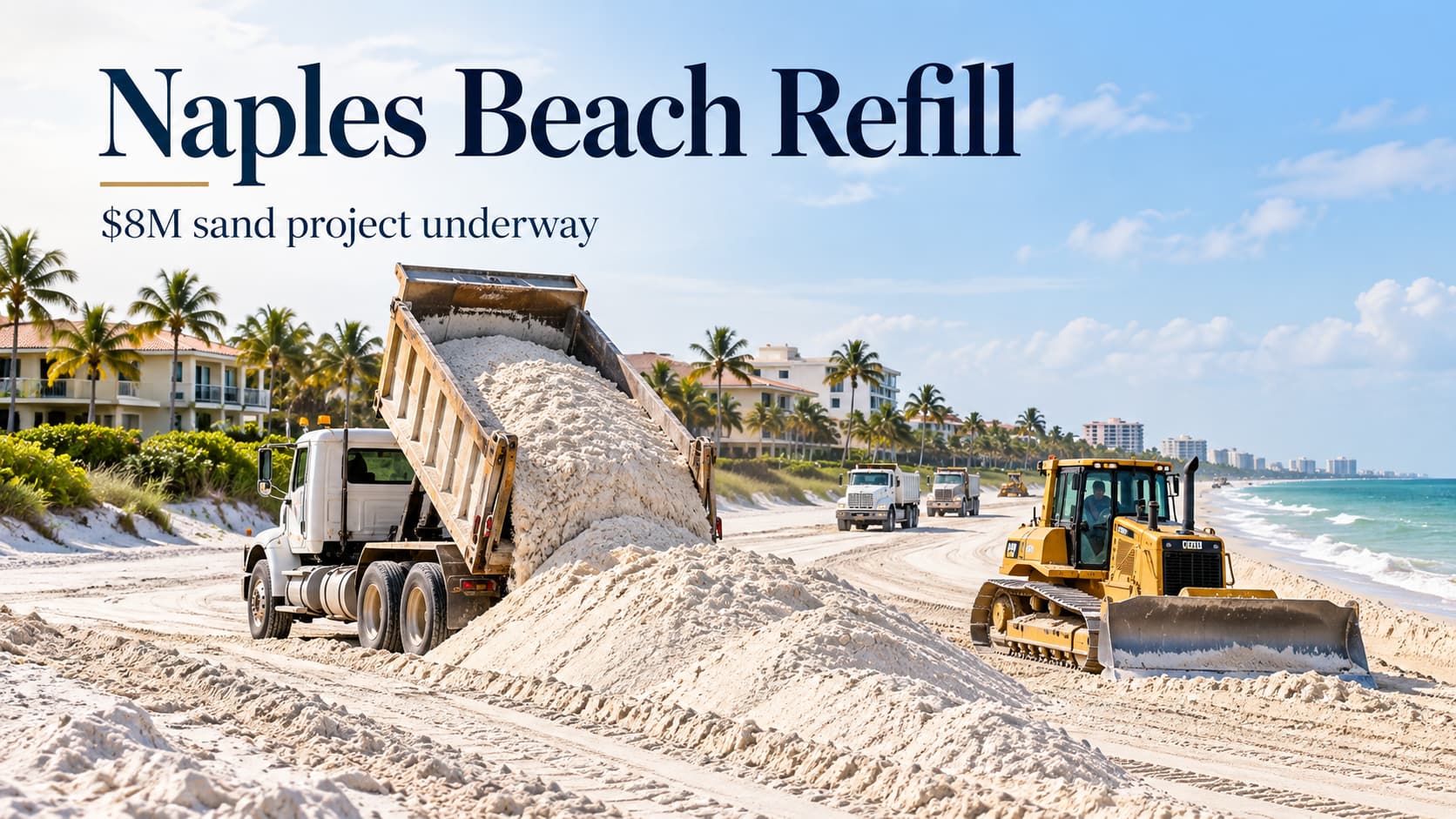
As of Monday, 9,450 truckloads of sand are making their way from a quarry in Immokalee to Naples Beach.
The destination: 3.5 miles of shoreline between Doctors Pass and just south of 21st Avenue South — a stretch that lost significant sand during Hurricanes Helene and Milton. The price tag: $8 million, funded entirely by Collier County’s tourist development tax.
The project is expected to wrap up by Christmas, just in time for season.
What’s Actually Happening
The contractor — Earth Tech Enterprises Inc. of Fort Myers — will place 208,000 tons of sand to rebuild the beach to a standard 85-foot width from the dune line to the Mean High Water Line. The $8 million breaks down as approximately $5 million for the construction contract, $2.4 million for sand acquisition from Stewart Materials in Immokalee, and the remainder covering engineering, permitting, inspections, and shorebird monitoring.
Work runs 7 a.m. to 7 p.m., Monday through Saturday. The beach stays open throughout, with sections temporarily closed as crews move through each area.
This Isn’t the First Time
This project is the latest in a long and recurring cycle of renourishment along Collier County’s coastline. It’s not a one-time fix — it’s a maintenance program that’s been running for decades.
A partial record of recent projects:
-
January–April 2025 — Park Shore Beach Renourishment, $5.5 million. Triggered by Hurricanes Debby, Helene, and Milton. Sand sourced from Stewart Materials in Immokalee.
-
2024–2025 — Vanderbilt Beach and Pelican Bay renourishment, approximately $7.5 million combined. Vanderbilt Beach funded by Tourist Development Tax; Pelican Bay funded separately by the Pelican Bay Services Division.
-
October–December 2026 — Current Naples Beach project, $8 million.
That’s more than $20 million in Collier County beach renourishment spending in roughly two years alone — and the county has been doing this, in various forms, for well over 20 years.
The Question Everyone Asks
A beachgoer captured the skepticism well when the project started Monday.
“I have concerns about the long-term viability of it as a project,” Cheryl Mueller told WINK News. “Each year we put sand in, and every year the ocean takes it away. With sea levels rising, I don’t know how long we can sustain this.”
It’s a fair question. So what does the data say?
The Return on Investment Is Exceptional
Florida’s Economic Demography Research office studied the state’s beach management program and found a return on investment of 5.4 — meaning for every $1 spent on beach restoration, approximately $5.40 in tourist tax revenue was generated. That ranked beach renourishment third among all Florida economic development programs, above Visit Florida advertising and most other state incentive programs.
Florida beach-oriented tourists generate roughly $23 billion in tax revenues annually. Beaches account for 25.5% of Florida’s attractiveness as a tourism destination — more than any other single factor. Half of all Florida tourists describe themselves as beach-oriented.
The Miami Beach example is the most dramatic illustration of what’s at stake. The area had almost no beach in the mid-1970s, causing tourism to collapse. After renourishment began in 1978, Miami Beach became the most valuable property in Florida by assessed value — worth more than all Florida cropland combined. The return there has been estimated at $550 in tourist taxes for every $1 spent on sand.
For Collier County, the math is straightforward: the beach drives the tourism that funds the Tourist Development Tax that pays for the renourishment. The beach creates the revenue. The revenue maintains the beach.
The Honest Caveat — And the Physics Behind It
Mueller’s concern isn’t wrong — it’s just incomplete. Here’s the actual mechanics of what’s happening, and why it matters for Naples’ long-term future.
When crews place 208,000 tons of sand on Naples Beach, they’re not restoring what was lost. They’re building a buffer — a sacrificial zone that sits between the Gulf and the streets, condos, and infrastructure behind it. The ocean erodes the new sand first, before it reaches buildings and roads. You’re not stopping the water. You’re absorbing it with sand instead of with property.
Think of it this way: the county is purchasing distance between the Gulf and Gulf Shore Boulevard. Every project pushes the waterline back out and buys a few more years of separation between the water and the street. That’s the model. It’s not permanent. It’s intentional and managed.
The Streets Don’t Move. The Water Does.
Here’s the problem that coastal science is increasingly clear about, even if local government hasn’t said it loudly enough yet.
Streets, seawalls, condos, and infrastructure are fixed. Sea levels are not. As the Gulf rises — slowly, measurably, consistently — the available space between the built environment and the water gets smaller. Every inch of sea level rise means you need more sand to maintain the same beach width, and you need it more frequently.
The stretch being renourished right now is designed to an 85-foot width from the dune line to the water. In 10 years, maintaining that same 85-foot width will cost more. In 20 years, more still. At some point — engineers and coastal scientists disagree on exactly when, but not on whether — the gap between fixed infrastructure and rising water becomes too narrow to hold a usable beach regardless of how much sand is added. The sand gets pushed against the seawall. The beach disappears.
That’s the long game nobody wants to talk about.
So Is It Still Worth It?
Yes — for now, and for any reasonable planning horizon in front of us.
The 5.4 return on investment is real. The tourism revenue that funds the very tax paying for this project is real. And for Naples specifically, the beach isn’t just an amenity — it is the economic engine that drives property values, hotel occupancy, restaurant revenue, and the tax base that funds everything else. A degraded Naples Beach is an economically different Naples.
The harder question — the one that will define coastal policy in Collier County over the next two decades — is whether sand-only renourishment is sufficient as a long-term strategy, or whether it needs to be paired with dune restoration, inlet sand management, and honest conversations about what parts of the built environment can and can’t be protected indefinitely as the Gulf continues to rise.
For now, 9,450 trucks are making the trip from Immokalee to the Gulf. Naples Beach will be beautiful for season. And the county will do this again — probably sooner than anyone would like.
Sources: WINK News, October 25 and October 13, 2026; Stormwater.com, January 2025; Gulfshore Business; Florida Economic Demography Research office Beach Management ROI Study; American Shore and Beach Preservation Association, Shore & Beach journal; Florida Shore and Beach Preservation Association Economic Fact Sheet.