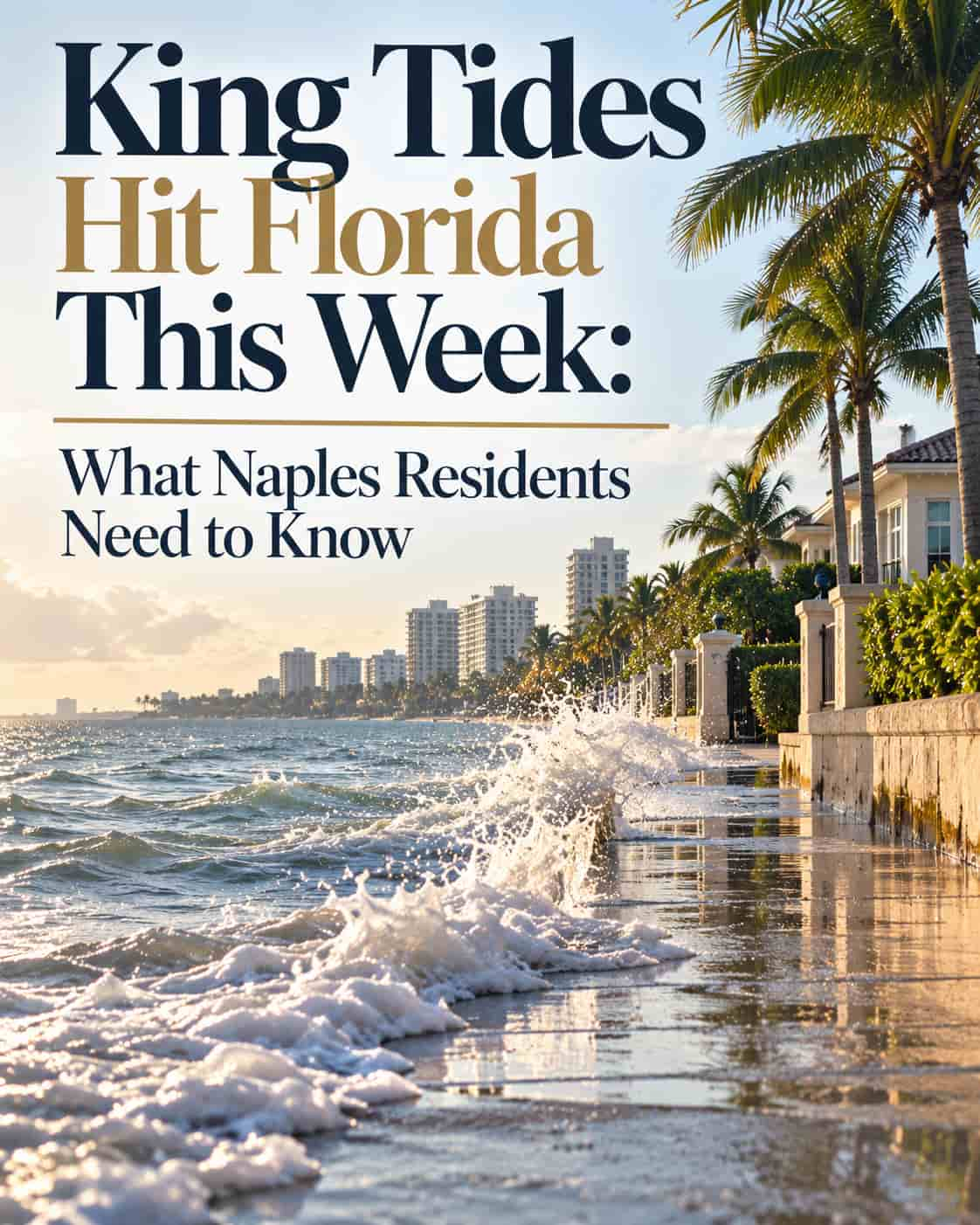
As parts of Florida battle coastal flooding, Naples faces its own stretch of unusually high tides—just as an $8 million project begins rebuilding the city's beaches.
On Monday, October 26, trucks began delivering sand to Naples Beach as part of an $8 million shoreline restoration project. Just as that work got underway, Florida entered one of its most significant king tide periods of the year.
Across parts of the state's Atlantic coastline, unusually high tides combined with strong winds are flooding streets, threatening waterfront properties, and creating hazardous beach conditions.
But here's the important distinction for Naples residents: While the Gulf Coast is experiencing elevated tides, forecasters are not predicting the same severe coastal flooding currently affecting Florida's east coast.
Still, the timing is a reminder of an increasingly important question for Southwest Florida: How do you protect a coastline when the water keeps coming higher?
What's Happening Along Florida's Coast?
King tides are exceptionally high tides that occur when astronomical conditions combine to create a greater-than-normal tidal range.
According to the South Florida Water Management District, the current king tide period is particularly significant along Florida's Atlantic coast, where October 27 is expected to bring some of the year's highest water levels.
Strong northeast winds have made matters worse on that side of the state, pushing water toward the coast and amplifying flooding around high tide.
The National Weather Service has warned of moderate to major coastal flooding in some Atlantic coastal communities, with hazardous surf and dangerous swimming conditions continuing into Wednesday.
Naples, however, is facing a different situation.
The South Florida Water Management District's October 26 forecast indicates that tidal water levels along South Florida's west coast may remain below the threshold for minor coastal flooding.
That doesn't mean every low-lying coastal location is immune to localized water problems. It does mean residents shouldn't assume the dramatic flooding reported in Miami, Fort Lauderdale, and other Atlantic communities is also happening in Naples.
When Will King Tides Affect Naples?
For Southwest Florida's Gulf Coast, the current elevated tide period runs from October 27 through October 29.
The predicted high tides at Naples' outer coast include:
-
Tuesday, October 27: Approximately 12:17 a.m. and 2:20 p.m.
-
Wednesday, October 28: Approximately 12:46 a.m. and 3:21 p.m.
-
Thursday, October 29: Approximately 1:22 a.m. and 4:28 p.m.
These are predicted tide times, not guarantees of flooding. Actual water levels depend on additional conditions, including wind, atmospheric pressure, and local geography.
Residents living near Naples Bay, tidal canals, and other low-lying waterfront areas should pay particular attention during high-tide periods, especially if weather conditions change.
What Exactly Is a King Tide?
Despite the dramatic name, a king tide isn't a hurricane, tropical storm, or even a weather event.
It's an astronomical occurrence.
The moon and sun exert gravitational forces on Earth's oceans. During certain new and full moons, those forces combine to produce higher-than-normal tides.
When the moon is also relatively close to Earth, the effect can become more pronounced.
King tides are predictable, but their impacts aren't always the same.
A king tide during calm weather may pass with little disruption. Combine that same tide with strong onshore winds, large waves, or a storm surge, and flooding can become much more serious.
There's another factor that makes these events increasingly relevant: rising sea levels.
As the average water level increases over time, exceptionally high tides can reach streets, drainage systems, and waterfront properties that previously stayed dry.
In that sense, king tides offer a glimpse of the coastal challenges communities may face more frequently in the future.
The $8 Million Naples Beach Connection
Here's where this week's timing gets particularly interesting.
On Monday, Collier County began placing new sand along approximately 3.5 miles of Naples Beach, stretching from Doctors Pass to just south of 21st Avenue South.
The project includes more than 208,000 tons of sand transported from Immokalee, at an estimated total cost of $8 million.
The work is designed to restore sand lost through erosion, including impacts from Hurricanes Helene and Milton in 2024.
Crews are scheduled to work Monday through Saturday, from 7 a.m. to 7 p.m., with completion expected before the end of 2026.
The beach will remain open, although small sections will be temporarily closed as crews move through the project.
And the funding? Collier County's tourist development tax, collected from visitors staying in hotels and other qualifying accommodations. The county may also seek reimbursement for eligible hurricane-related expenses.
Why Keep Adding Sand If the Gulf Takes It Away?
It's a reasonable question.
Beach renourishment isn't designed to permanently stop erosion. Instead, it restores the beach's width and provides additional sand that can help absorb wave energy and protect the shoreline.
Over time, waves, currents, storms, and seasonal conditions redistribute that sand.
That's why beach restoration is an ongoing maintenance responsibility, not a one-time construction project.
King tides are part of the larger coastal picture, although a high tide alone doesn't necessarily cause significant erosion. Wave energy, currents, and storm conditions are major factors in determining how much sand actually moves.
There is no verified evidence that this week's high tides have already damaged Naples' newly placed sand.
What Naples Residents Should Watch For
Even without a major coastal flood warning for Naples, residents and beachgoers should remain aware of changing conditions.
-
Waterfront streets and neighborhoods: Watch for unusually high water near tidal inlets, seawalls, and low-lying drainage areas.
-
Beach access: Follow posted closures and avoid active construction zones along the renourishment project.
-
Boating conditions: The National Weather Service has issued Small Craft Advisories for Gulf waters through Wednesday. Check current marine forecasts before heading offshore.
-
Swimming: Pay attention to local beach flags, surf conditions, and any swimming advisories. High tides alone do not establish a high rip-current risk.
-
Flooded roads: Never drive through water of unknown depth, particularly when saltwater flooding is possible.
Residents can monitor official forecasts from the National Weather Service and the South Florida Water Management District.
For questions specifically about the Naples Beach renourishment project, Collier County Coastal Zone Management can be reached at 239-252-2922.
The Bigger Picture for Naples
For now, the strongest king tide flooding is occurring on Florida's Atlantic coast, not along Naples Beach.
But the larger lesson applies to both coastlines.
Naples depends on its beaches for tourism, recreation, property protection, and the coastal lifestyle that makes this community distinctive.
Maintaining those beaches requires continuing investment, careful planning, and an understanding that the shoreline is constantly changing.
This week's elevated tides and the newly launched beach restoration project aren't evidence that Naples is in immediate danger.
They are, however, two timely reminders of the same reality: The coastline never stands still, even when everything built behind it does.
Sources: AccuWeather, October 26, 2026; USA TODAY Network-Florida, October 27, 2026; WPTV, October 27, 2026; News4Jax, October 26, 2026; National Weather Service.