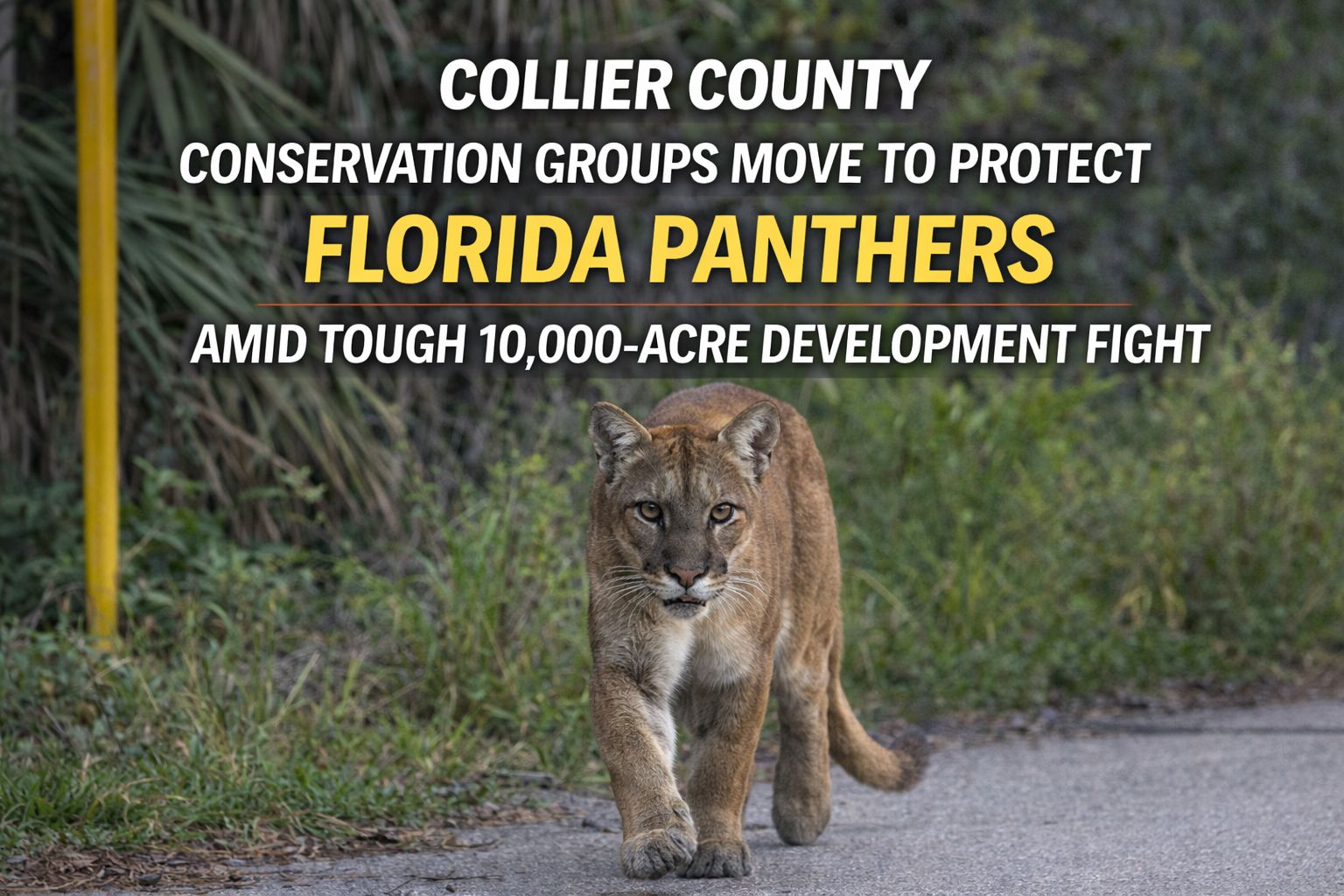
A major environmental battle is brewing in Collier County as conservation organizations prepare legal action to challenge a massive residential and commercial development they say threatens critical Florida panther habitat.
The ongoing debate centers on a planned community known as Rural Lands West, a more than 10,000-acre project proposed west of Ave Maria and east of Golden Gate Estates. While developers and some government agencies have approved moving forward with the plan, environmental advocates warn the site lies within important habitat that panthers rely on for roaming and breeding — raising alarm about how continued growth could impact an already endangered species.
What’s Driving the Conservation Push
Collier County has long been at the intersection of growth and environmental preservation. The rural lands in question sit near protected areas such as the Florida Panther National Wildlife Refuge, part of the broader network of habitat dedicated to protecting this iconic animal. Panthers, a subspecies of cougar native to Florida, once roamed widely across the region but now number only in the low hundreds.
Conservation groups including the Center for Biological Diversity and the South Florida Wildlands Association have formally notified federal agencies — including the U.S. Fish and Wildlife Service and the U.S. Army Corps of Engineers — of their intent to file a lawsuit if agencies do not re-evaluate their approval of the Rural Lands West plan under the Endangered Species Act. These organizations argue that the current biological opinion failed to fully assess how large-scale development would affect the long-term survival and recovery of the panther population.
Habitat Loss and Cumulative Impacts
The legal challenge frames the issue as more than a single development project; it highlights years of habitat loss due to sprawling residential projects, roads, and commercial growth across Southwest Florida. Experts say that panthers require large, contiguous, roadless areas to survive and reproduce. As habitat shrinks, encounters with vehicles and human activity increase mortality rates, making conservation strategy a critical part of regional planning.
In recent years, wildlife officials have reported panther deaths from vehicle collisions in the county, underscoring the dangers these cats face when their traditional roaming corridors are interrupted by roads and development.
The Stakes for Species Survival
Panther advocates characterize the moment as pivotal. With estimates suggesting fewer than 200 adult Florida panthers remain in the wild, each decision about land use carries outsized consequences. Their survival hinges not only on protected preserves and refuges but on development decisions surrounding adjacent lands used for breeding, hunting, and migration.
Both sides are now watching the federal response to the conservation groups’ notice. If agencies fail to revise their biological assessment within the statutory timeframe, formal litigation could move forward, potentially reshaping how large growth projects are evaluated in relation to endangered species protections.
Looking Ahead
As Collier County continues to grow, the balance between economic development and ecological stewardship remains at the forefront of public discourse. The outcome of this legal challenge could have far-reaching implications for future planning decisions, not only for the Rural Lands West project but for how endangered species are considered in land use policy across Southwest Florida.