Something big is happening inside hospitals across Southwest Florida—and most people don’t even realize it yet.
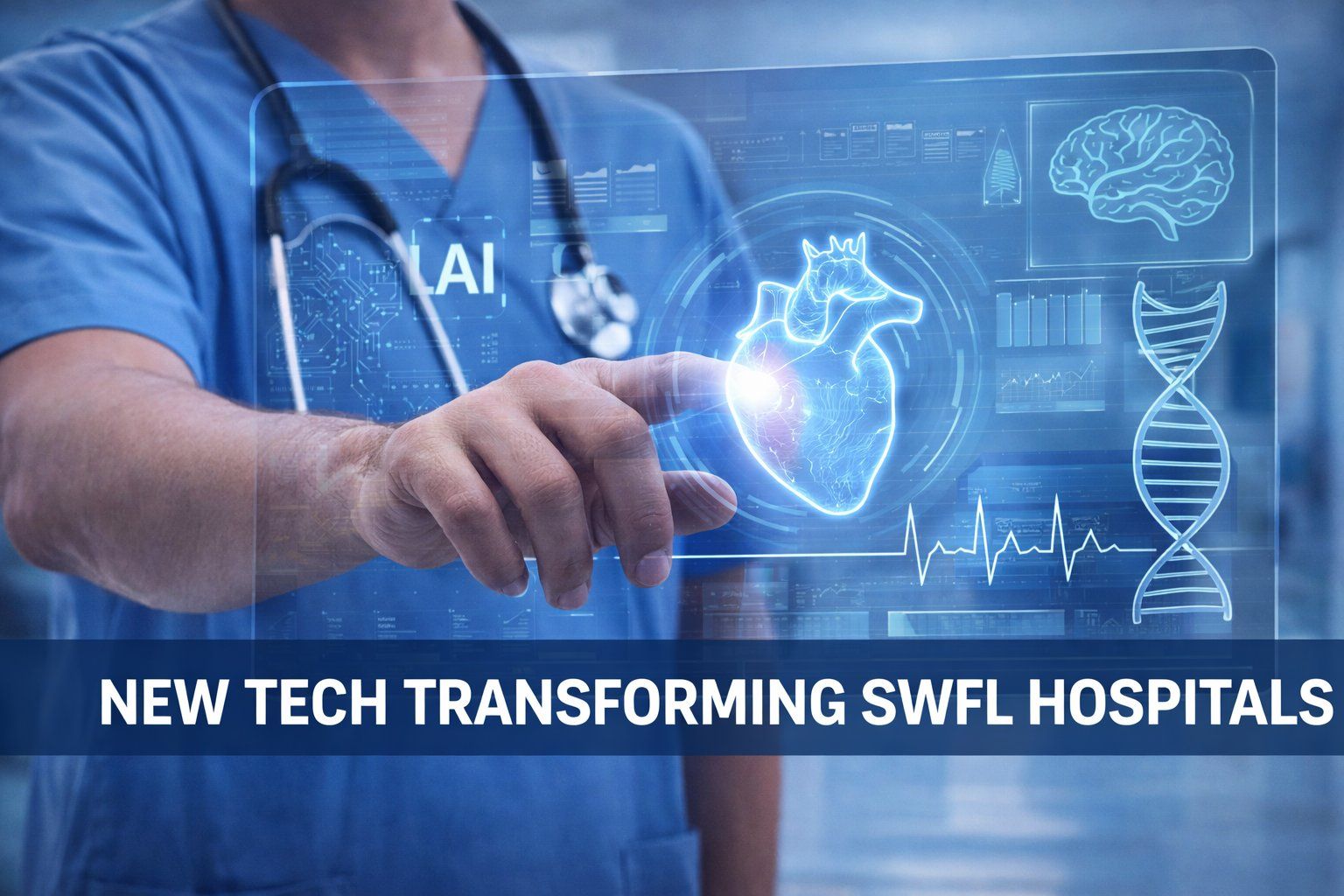
From Naples to Tampa, healthcare systems are rapidly adopting new technologies designed to make care faster, more accurate, and more efficient. It’s not just small upgrades either. We’re talking about artificial intelligence, predictive diagnostics, and tools that are starting to change how doctors actually treat patients.
And in many cases, it’s already happening right here in Naples.
Across the region, hospitals are investing heavily in tech not just to improve outcomes, but to solve one of the biggest challenges in healthcare today: staffing shortages. Industry leaders say automation and AI could be as transformative to healthcare as the internet was to business—especially when it comes to reducing workload and improving efficiency.
That shift is already showing up in real ways.
At Naples Comprehensive Health, for example, doctors are now using AI-powered digital stethoscopes that can detect heart conditions in real time. Instead of relying solely on human hearing, the technology analyzes sound data instantly and flags potential issues that might otherwise go unnoticed. In one study, it helped identify dozens of patients with previously undetected heart disease—giving them a chance to treat it earlier.
That’s not just innovation—it’s prevention.
And it’s only one example.
Zoom out across Southwest Florida and the broader region, and the pattern becomes clear.
Hospitals are moving toward more predictive, personalized care.
That includes technologies like AI-assisted imaging, advanced surgical systems, and integrated data platforms that allow providers to make faster, more informed decisions. In some cases, entire hospital systems are investing hundreds of millions into unified digital records and platforms that streamline everything from patient intake to treatment planning.
Even procedures themselves are changing.
New AI-assisted tools are being used during colonoscopies to detect abnormalities in real time—an extra layer of precision that helps doctors catch issues that might otherwise be missed.
In operating rooms, next-generation imaging systems are making minimally invasive surgeries more efficient, giving surgeons better visibility and flexibility while reducing recovery time for patients.
And on the administrative side, AI is starting to take over one of the biggest pain points in healthcare: documentation.
Some hospitals are now using “ambient listening” technology that records patient conversations and automatically turns them into clinical notes, freeing up nurses and doctors to spend more time actually treating patients instead of typing.
All of this points to something bigger.
Healthcare in Southwest Florida isn’t just growing—it’s evolving.
And it’s doing it quickly.
That matters in a region like Naples, where population growth—especially among older residents—is driving demand for more advanced care. As more people move to Southwest Florida, healthcare systems are being forced to scale not just in size, but in capability.
Technology is how they’re doing it.
Instead of simply adding more staff or expanding buildings, hospitals are becoming more efficient, more data-driven, and more proactive in how they treat patients.
That’s a different model than what most people are used to.
There’s also a long-term impact that goes beyond healthcare itself.
As hospitals invest in advanced technology, they attract a different level of talent—specialists, researchers, and highly trained professionals who want to work with cutting-edge systems. That can have a ripple effect on the local economy, bringing more high-skilled jobs into the region and strengthening one of the few industries in Southwest Florida that offers long-term career growth.
In that sense, this isn’t just a healthcare story.
Of course, none of this comes without questions.
Cost is always part of the conversation. New technology is expensive, and healthcare affordability remains a major concern across the country. But leaders in the industry increasingly see technology as part of the solution—not just the problem—especially if it leads to earlier detection, fewer complications, and more efficient care overall.
For Naples, this is one of those quiet shifts that doesn’t always make headlines—but probably should.
Because while new developments and real estate tend to dominate the conversation, what’s happening inside the region’s hospitals may have an even bigger long-term impact.
Healthcare isn’t just expanding. It’s getting smarter.
This story is based on reporting from Business Observer.