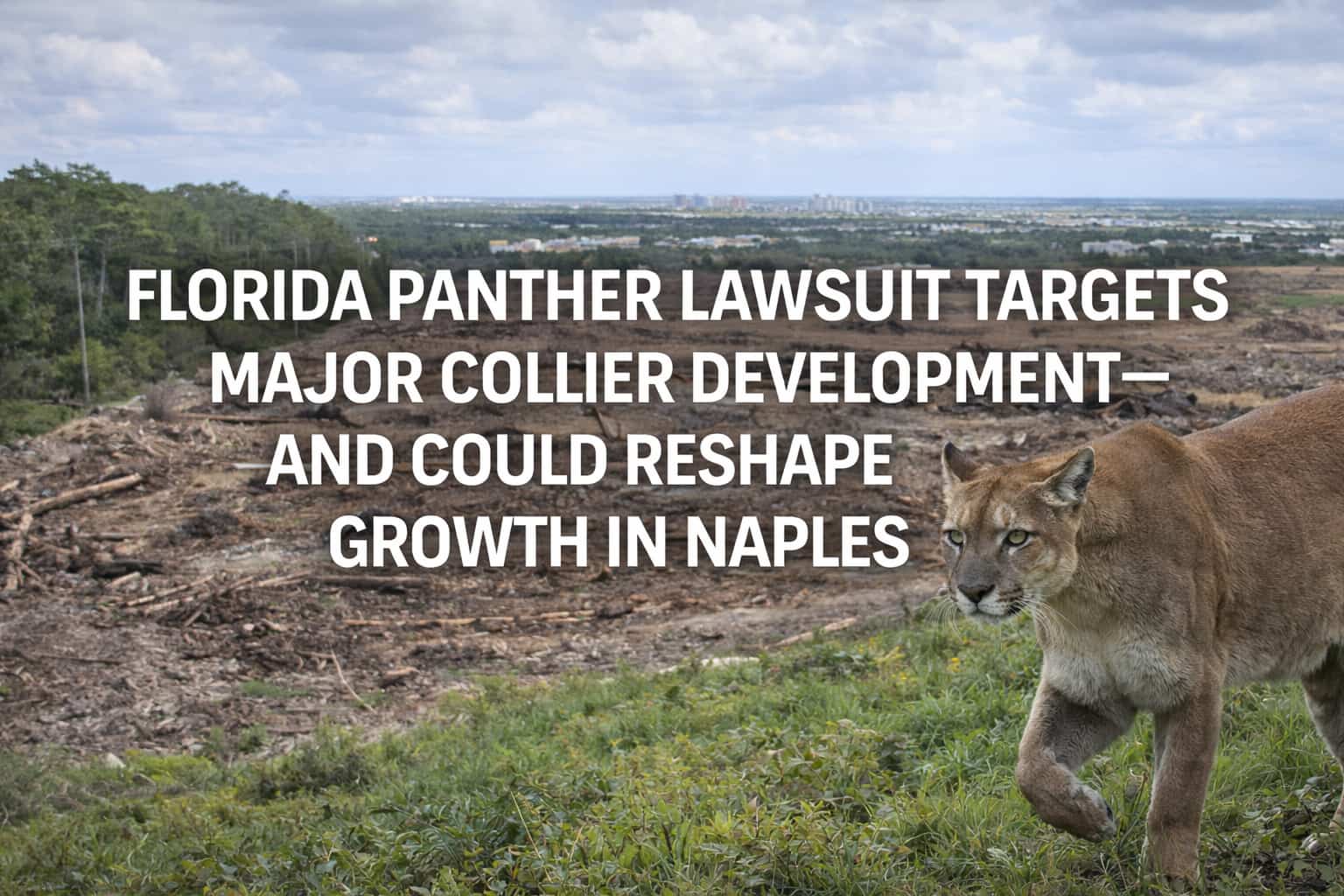
A major development project in Collier County is now at the center of a growing legal battle—and it’s not just about land.
It’s about the future of Southwest Florida.
Environmental groups have filed a lawsuit challenging federal approval of a massive development planned for eastern Collier County, arguing it could threaten one of the region’s most iconic—and endangered—species: the Florida panther.
The project, known as Rural Lands West (also tied to the broader “Big Cypress” vision), spans more than 10,000 acres and could bring thousands of homes, commercial space, and infrastructure to an area east of Naples that has long been considered critical wildlife habitat.
That’s where the conflict begins.
On one side, you have growth.
Southwest Florida continues to expand, with new residents, new demand for housing, and ongoing pressure to build. Large-scale developments like this are often seen as necessary to keep up—especially as inland areas become the next frontier for growth.
On the other side, you have conservation.
Groups behind the lawsuit argue the project sits directly in prime panther habitat—land that is essential for the species to survive and expand its population. They claim federal agencies violated the Endangered Species Act by approving the project without fully accounting for its long-term impact.
Florida panthers are already one of the most endangered mammals in the United States, with fewer than a few hundred remaining in the wild.
As development continues across South Florida, the land available for panthers to roam, hunt, and reproduce continues to shrink. Roads and expanding communities also increase the risk of vehicle collisions—one of the leading causes of panther deaths.
In other words, where we build matters.
And that’s what makes this lawsuit different from a typical development dispute.
This isn’t just about density, traffic, or neighborhood character.
It’s about whether growth in Southwest Florida is crossing a line—one that could have irreversible consequences.
The proposed development sits not far from protected areas like the Florida Panther National Wildlife Refuge, a region specifically set aside to help preserve the species.
Conservationists argue that projects like this don’t just chip away at habitat—they fragment it, making it harder for panthers to move, find mates, and sustain a healthy population.
At a certain point, they say, it becomes a tipping point.
But from a development standpoint, the argument looks different.
Collier County has limited space left to build, especially along the coast. Inland expansion is one of the only viable paths forward, and projects like Rural Lands West are designed to accommodate long-term growth.
It’s not just housing—it’s entire communities.
And for many, that growth is necessary.
That’s why this case matters.
It highlights one of the biggest questions facing Naples and Southwest Florida right now:
👉 How do you balance growth with preservation?
Because both sides are real.
-
The need for housing is real
-
The pressure from population growth is real
-
And the risk to wildlife and natural ecosystems is real
For now, the lawsuit will move through the courts, and the outcome could have major implications—not just for this project, but for future development across Collier County.
If the challenge succeeds, it could slow or reshape large-scale projects in environmentally sensitive areas.
If it doesn’t, it could signal that development will continue pushing deeper inland.
Either way, this isn’t just another local story.
It’s a glimpse into the future of Southwest Florida.
Because as Naples continues to grow, decisions like this will determine what that growth actually looks like—and what gets left behind.
This story is based on reporting from Naples Daily News and additional environmental and legal filings related to the Florida panther lawsuit